Tag Archives: robin

Animals of the Nativity- The Donkey

The Christmas period is filled with the images of animals from robins to reindeer. One of the most important images to feature on Christmas cards and decorations is the nativity. Have you ever wondered about the animals’ origins and their roles in this iconic Christmas scene? This series explores the species that surround the manger.

The Donkey

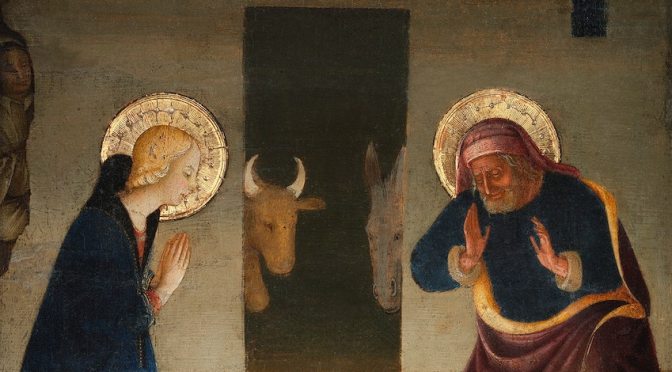
Often perceived as stubborn and described as beasts of burden, donkeys have a fascinating origin and are essential to all nativities. Early Christians of the fourth century created windows and alfresco nativity scenes which featured a donkey alongside an ox.  According to the prophet Isaiah in the Old Testament

“The ox knows its owner and the donkey its master’s manger; Israel has no knowledge, my people have no understanding” (Isa 1: 2-3).

Historians have interpreted this scripture to mean that both animals know their place by serving people in their livelihoods, such as working in the fields or in the marketplace. In a recent article published in Science, researchers found evidence that donkeys first became domesticated seven thousand years ago when herders in Kenya and the Horn of Africa began taming Equus africanus – wild African ass. Five thousand years ago domesticated donkeys began to expand their range as trading spread from Egypt to Sudan, and by two thousand five hundred years ago the species had populations in Asia and Europe

According to the charity, Spana, there are forty-two million working donkeys worldwide. Unlike their domestic relatives, Equus africanus – wild African ass, is critically endangered, according to the International Union for Conservation of Nature.  There are currently only twenty-three to two hundred Equus africanus in the wild today.  

In the time of the nativity, donkeys were a common form of transport and would have been the only transport option available for people of  Joseph and Mary’s status.   
Five British Bird species to spot this Winter


The UK is brimming with spectacular bird life throughout the winter months from gardens to parks, and hedgerows. This is a particularly good time of year to see birds from the order of passerine which can be recognized by their toe formation, with three toes pointing forward and another one facing backward which enables them to perch on branches.

Here are five species to look out for:

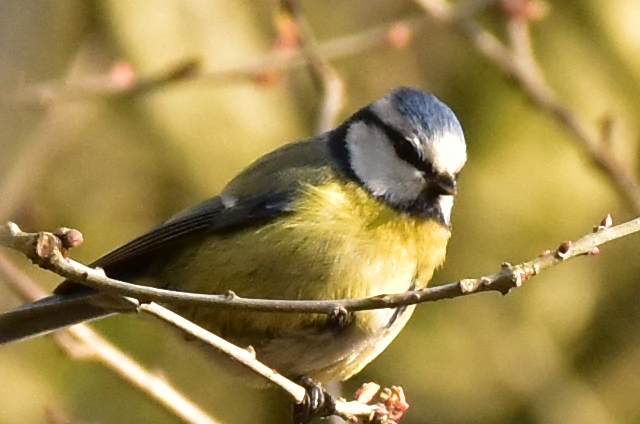
  1. Blue Tit

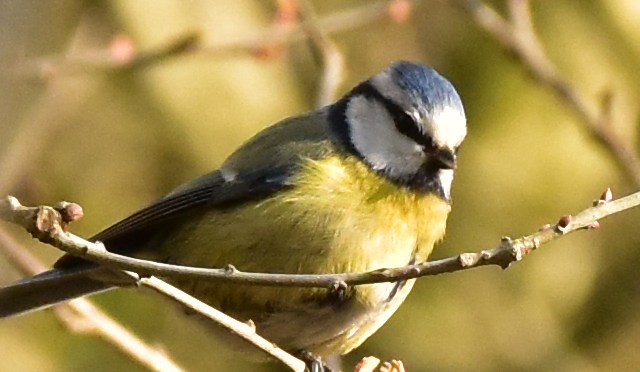
The blue tit is instantly recognizable by its colourful assortment of plumage, which includes blue, yellow, white, and green. In the winter, they can be observed feeding in family flocks and are often joined by other tit species. Blue tits are regularly confused with great tits because they share the same colour feathers. An easy way to distinguish between both species is to look at their marking. The head of the great tit is black and white with a broad black bib that runs centrally through its yellow underparts. Whereas the blue tit has a blue crown, a white face, and black eye stripes. 


Blue tit perched on a branch
Blue tit perched on a branch – photo by Ellie May Forrester

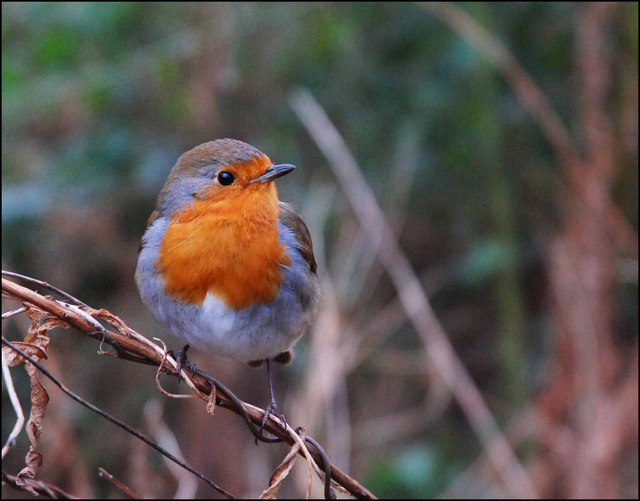
2. Robin

The robin is one of the UK’s most iconic bird species and is immediately recognizable because of its red breast and face it also has a brown feathered back and a yellowish-white belly. Robins have a wingspan of twenty to twenty-two centimetres and can weigh between fourteen to twenty-one grams.  Unlike, the adorable birds that adorn our Christmas cards every year, robins are very territorial and will actively scare intruders away.    


Robin on a branch
Robin by Debbie Turner is licensed under CC-BY-SA 2.0

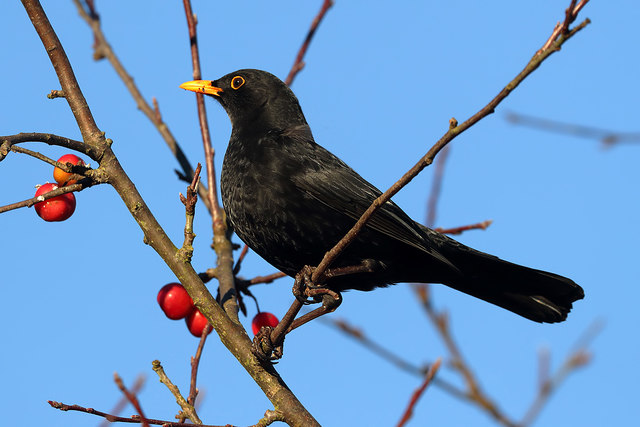
3. Blackbird

The male blackbird has a yellow-ringed eye, yellow beak, and black plumage. Whereas the female has brown feathers and a brown beak. They eat a wide range of food including earthworms, caterpillars, and berries. Blackbirds are seen often foraging in the undergrowth where they turn over leaves looking for food. 


4. Long-tail tit

The long-tail tit is a small black, white, and pink fluffy feathered bird with a tail that makes up half its body length.  Long-tail tits have a distinctive broad black stripe over their eyes and can be seen in flocks of up to twenty birds. These are gregarious and noisy birds that huddle together throughout the winter. Their flight is weak and undulating as they string from one tree to another. 


Two long-tailed tits sat on branch
Long-tailed Tits by Mick Lobb is licensed under CC-BY-SA 2.0

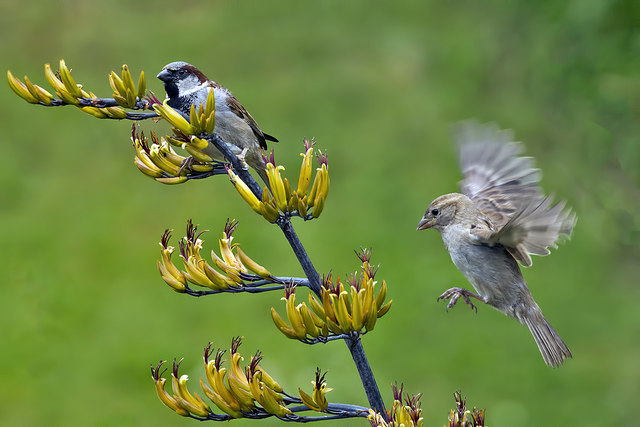
5. House Sparrow

The male and female house sparrows are distinctively different in their markings and colourful  plumage.  Males have a chestnut brown mantle, a grey crown, and a black chin and throat. Females are plain brown with grey under-parts and their back feathers are made up of both black and brown stripes.  Being gregarious in nature has allowed the house sparrow to exploit human rubbish enabling them to colonize the globe.